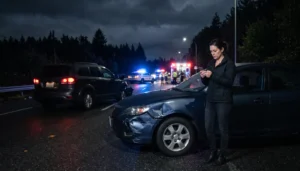
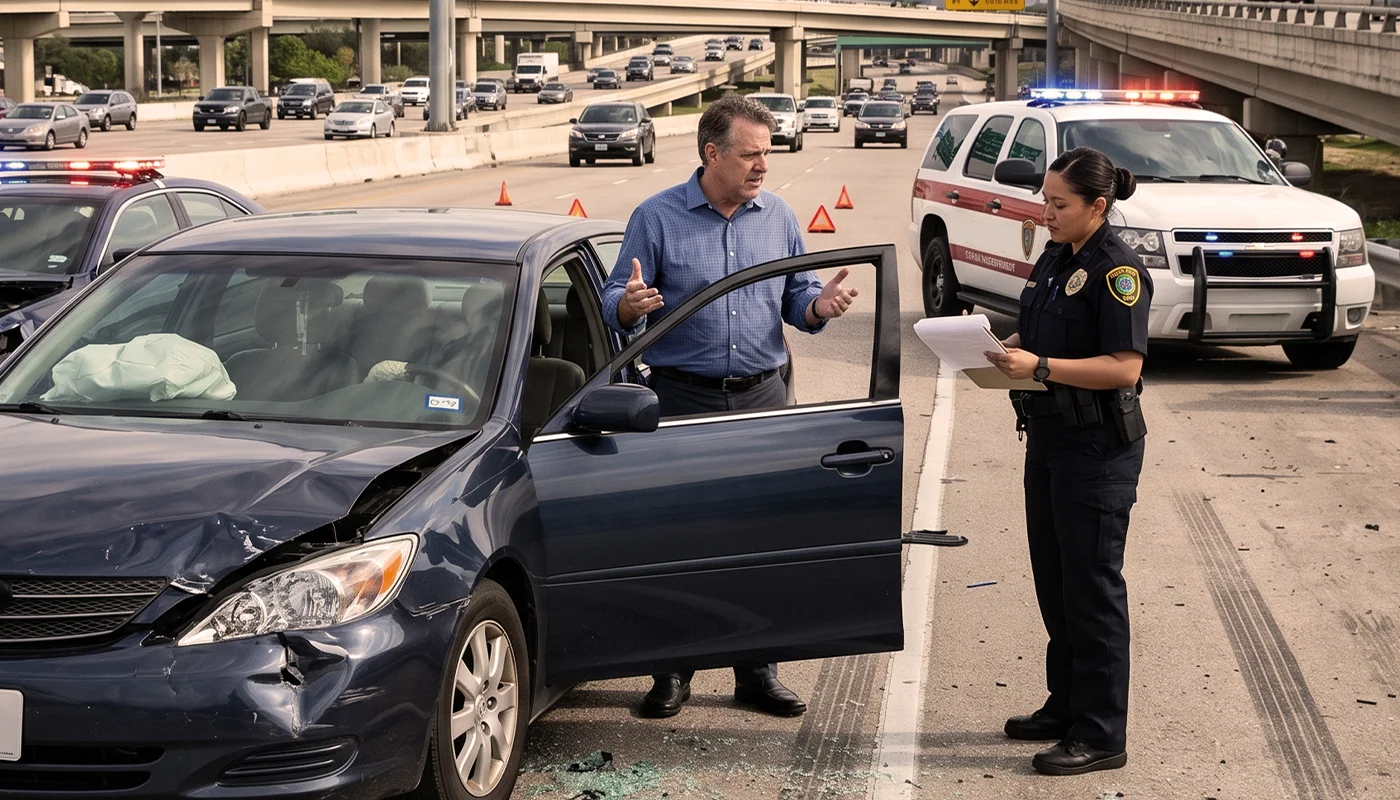

Realizing you might be at fault for a car accident is a different kind of stressful than being the injured party. Instead of wondering how you will get compensated, you are suddenly wondering what this is going to cost you, how much your insurance will actually cover, and whether you could end up personally on the hook for the rest. I get calls from people in exactly this situation all the time, and the good news is that being at fault does not automatically mean your life is about to fall apart financially, but it does mean you need to understand exactly what happens next.
Texas is an at-fault state, which means the driver who caused the accident is generally responsible for covering the resulting damages. Knowing what to do after a car accident matters just as much when you think you are the one at fault, because how you handle those first hours and days can significantly affect what happens later.
What Does “At Fault” Mean in a Texas Car Accident?
Being at fault means your actions or negligence were the primary cause of the accident. This can involve speeding, distracted driving, running a red light, following too closely, or any other behavior that fails to meet the standard of care a reasonable driver would exercise. Once fault is assigned, it becomes the foundation for who is financially responsible for the injuries and property damage that resulted from the crash.
How Is Fault Determined in Houston Car Accidents?
Fault is not simply decided on the spot at the scene. It is determined through a review of evidence gathered in the hours, days, and sometimes weeks following the accident.
- Police reports documenting the officer’s observations, a diagram of the scene, and statements taken from both drivers
- Photographs and video capturing vehicle positions, road conditions, traffic signals, and visible damage
- Skid marks, debris patterns, and the paths vehicles traveled before and after impact
- Witness statements from anyone who saw the accident happen
- Expert accident reconstruction analysis in more serious or disputed cases
I always tell clients that an initial fault determination is not necessarily final. New evidence can shift the outcome, which is exactly why disputing an unfair fault assignment is sometimes the most important thing I do for a client.
What Happens to Your Insurance if You Are At Fault?
If you are found at fault, your liability insurance is what responds to the other driver’s claim. Under Texas Transportation Code Section 601.072, Texas drivers are required to carry minimum liability coverage of $30,000 for bodily injury per person, $60,000 per accident, and $25,000 for property damage, commonly referred to as 30/60/25 coverage. Your insurer will use this coverage to pay for the other driver’s medical bills, lost wages, and property damage, up to your policy limits. Being at fault will also typically raise your premiums at your next renewal, since insurers view an at-fault accident as a strong indicator of increased risk. It’s also worth understanding how long an accident stays on your insurance in Texas, since that timeline directly affects how long you will be paying higher rates.
Can You Still Recover Compensation if You Are Partially At Fault?
Yes, in many cases. Under Texas’s modified comparative negligence rule, you can still recover compensation for your own damages as long as you are found 50 percent or less at fault. Your recovery is simply reduced by your percentage of responsibility. For example, if a court awards $100,000 and you are found 20 percent at fault, you would receive $80,000. If you are found 51 percent or more at fault, Texas law bars you from recovering anything at all, which is why disputing an inflated fault percentage is often worth fighting for even in shared-fault situations.
What Happens if the Damages Exceed Your Policy Limits?
This is where things can get financially serious. If the injured party’s damages exceed your insurance policy limits, whatever amount remains becomes your personal responsibility to pay. This is especially common in accidents involving serious injuries, hospitalization, or long-term care, where medical costs alone can quickly climb past minimum coverage limits. I always encourage clients to review their coverage before they ever need it, because minimum liability limits in Texas are often not enough to fully protect you in a serious crash.
Can You Be Sued Personally for an At-Fault Accident?
Yes. If your insurance does not fully cover the injured party’s damages, they have the option to file a personal injury lawsuit directly against you to recover the remaining amount. If a person died as a result of the accident, their family could also pursue a wrongful death claim. Understanding how car accident compensation works helps you see the full picture of what a plaintiff might be entitled to pursue beyond what your insurance alone would pay.
How I Can Help After an At-Fault Accident
Being told you are at fault does not mean the conversation is over. I review every detail of the car accident insurance claim process to make sure the fault determination is accurate and that you are not being blamed for more than your actual share.
- I investigate the accident independently rather than accepting the insurance company’s initial fault determination at face value
- I challenge fault percentages that do not match the actual evidence from the scene
- I make sure your policy limits are properly applied and that you understand your full financial exposure
- I protect you if the other party threatens or files a personal lawsuit against you directly
Get Legal Help Today
Finding out you may be at fault for a car accident does not mean you have no options left. Whether you need help disputing an unfair fault determination or understanding what your insurance actually covers, contact me today for a free case evaluation. I will review the facts, explain exactly where you stand under Texas law, and fight to protect your interests every step of the way.